Encouraging learning
Encouraging learning: School age (7-10 years)
From 7 to 10, school asks more, and homework and screens can fill the evenings. What helps at home is steady and low-key: a homework routine, better ways to practice, real choices and protected sleep.
Start here
- Agree on a homework time and place. Stay available, but let your child do the work.
- Swap rereading for self-quizzing: cover it, recall it, check it. Spread practice over several days.
- Praise effort and strategies, not intelligence.
- Let your child make real choices, like which subject comes first or which book to read next.
- Protect 9-12 hours of sleep and keep screens away from bedtime.123117
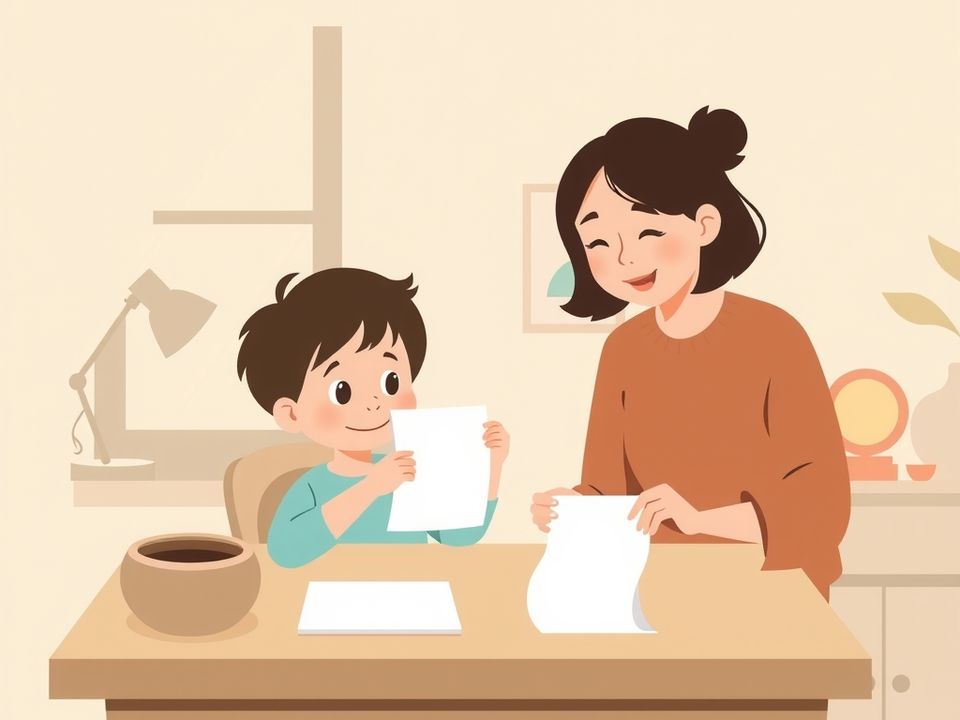
Homework
Keep homework low-stress. In a review of US homework research, correlational studies found a weaker link between homework and achievement in kindergarten to grade 6 than in grades 7-12, and every study had design flaws.113
The kind of involvement matters. When parents were trained to support homework, elementary school children completed more of it, had fewer homework problems and possibly did better at school; in correlational studies from elementary to high school, parents setting rules had a stronger link with outcomes than other kinds of involvement.124 Hands-on help is different. In a meta-analysis of 448 studies, nearly all kinds of parent involvement, such as talking about school or going to school events, had small positive links with achievement, engagement and motivation. The exception was homework help, which went with lower achievement, though not with lower motivation.111 A meta-analysis of 50 middle school studies found the same exception.118 Mixed evidence. These are correlations, so they cannot tell whether help lowers achievement or whether children who struggle get more help.
- Set the routine together: when, where, and what comes after.
- Be nearby. If your child asks for help, ask what they have tried, then give a hint, not the answer.
- Check that it is done, not that every answer is right. Mistakes show the teacher what to reteach.
- If homework often takes far longer than the school expects or ends in tears, talk to the teacher.
See also Homework, and Routines and visual schedules.
Studying that sticks
The study habits that feel productive are not always the ones that work. In two experiments, students who practiced recalling a passage remembered much more 2 days or 1 week later than students who reread it, even though rereading did better on a test after 5 minutes and made students more confident.151 A meta-analysis found practice tests more helpful than restudying or any other comparison, though the benefit varied with the learners and the study.126 A systematic review of 50 classroom experiments found medium or large benefits in most cases (57%), though only 6% took place outside WEIRD (Western, educated, industrialized, rich and democratic) countries.127 In one experiment, first and third graders both benefited from testing, but only the third graders realized it.145
Spacing is the other half. A major review of 10 study techniques rated practice testing and spaced (distributed) practice as highly useful, because they help learners of different ages and abilities.137 A meta-analysis of 317 experiments found that the best gap between study sessions grows as the time until the test grows.132
- Flashcards: answer on the back, sorted into “know it” and “not yet”.
- Close the book, say or write what you remember, then check. Dictation counts.
- For a Friday test, do short sessions on Monday, Wednesday and Thursday rather than one long one on Thursday night.
Reading for pleasure
Once children can read alone, reading can turn into one more piece of homework. Try to keep it a pleasure. A meta-analysis of 99 studies, from preschool to university, found that children and students who read more in their free time tended to read and spell better, and weaker readers seemed to benefit too; the studies show a link, not proof of cause.147 In 41 summer reading programs from kindergarten to grade 8, home programs built around children’s own book reading improved reading, and overall the summer programs helped children from low-income families more.142
- Let your child choose, including comics and long series.
- Keep reading aloud if they still enjoy it.
- Do not pay per book (see motivation).
Math at home
A meta-analysis of 64 studies found that a richer home math environment (math activities, but also attitudes, expectations and talk about math at home) went with higher math achievement (r = .13, see effect sizes). It is a correlation, and studies differed widely.133 Everyday chances: an allowance, shopping, cooking, keeping time, and card games such as the 24 game.
Praise and mindset
Praise what your child did rather than who they are. In six lab studies with fifth graders, children praised for intelligence rather than effort cared more about performing well than about learning, and after a failure they persisted less, enjoyed the task less and did worse.149 In a study of 313 children (average age 10.4), praise for personal qualities, but not for what they did, made children more likely to feel ashamed after failure, especially those with low self-esteem.128 Mixed evidence. A small long-term study of 53 children found that a higher share of praise for effort and strategies at ages 1-3 predicted better math and reading comprehension in fourth grade, a link that ran through children’s belief that intelligence can grow; praise for inborn traits was not linked to later beliefs that ability is fixed.141140 Mixed evidence.
You stuck with that problem and found a new way in.
What about growth mindset?
Your child’s school may teach a growth mindset: the belief that ability can grow with effort. Two large meta-analyses found the effects of mindset programs on achievement weak overall; in the later one, the small average effect was no longer significant after correcting for possible publication bias, or in the highest-quality studies.153146 Mixed evidence. Another found effects (d = 0.14) for targeted groups when programs were delivered as designed, and a national US experiment with teenagers found that a short online program raised lower achievers’ grades.129160 Mixed evidence. So process praise is a sensible daily habit, but do not expect a mindset lesson on its own to transform grades.
Motivation
In a meta-analysis of 36 studies, parents’ support for their child’s autonomy was linked with higher achievement and with children’s own motivation, engagement, positive attitudes toward school and, most strongly, psychological health.157 Autonomy support is not permissiveness: researchers treat the two as different things.80 In daily life it can look like real choices within your limits, reasons for your rules, and taking your child’s point of view seriously. Choice itself helps: in a meta-analysis of 41 studies, being given choices raised intrinsic motivation, effort and performance, and the boost to motivation was stronger for children than for adults.46
Rewards are debated. One meta-analysis of 128 studies found that rewards for doing, finishing or doing well at a task lowered later free-choice interest, with tangible rewards tending to be more harmful for children than for college students.134 Another concluded that rewards are generally not harmful, and that rewards tied to the level of performance did not lower motivation.131 Mixed evidence. So whether money for good grades backfires is disputed. Both found harm from promised, tangible rewards for tasks that were already interesting, and benefits from verbal praise, though one found praise tended to help children less than college students.134131
In practice: offer real choices, and do not pay for reading or hobbies your child already enjoys. More in Offering choices and Family meetings.
Focus, planning and self-control
A review names three core executive functions (self-control, working memory and mental flexibility) and notes that stress, lack of sleep, loneliness and lack of exercise each impair them.72
These skills can be trained, but there is no quick fix. Programs for children aged 4-12 that improved these skills, from martial arts and aerobic exercise to games, mindfulness and school curricula, all involved repeated practice that grew harder over time.135 Mixed evidence. A series of meta-analyses (children up to 12) found no convincing evidence that training gains last, and found that approaches that build these skills indirectly worked as well as or better than drills, were more enjoyable and fit more easily into everyday life.155 Mixed evidence.
- Pick activities that take practice and get harder: a sport, an instrument, chess.
- Help with planning: break big tasks into steps, use a checklist, work in short blocks.
Sleep and screens
The American Academy of Sleep Medicine, in a statement endorsed by the American Academy of Pediatrics (AAP), recommends 9-12 hours of sleep in every 24 hours for children aged 6-12, and links getting enough sleep regularly with better attention, behavior, learning, memory and emotional regulation.123
In a systematic review of 67 studies of school-aged children and teenagers, 90% linked screen time with worse sleep, mainly shorter sleep and later bedtimes. Cause and effect was not confirmed, and the authors advise limiting screens, especially before and during bedtime hours.117 The AAP’s 2026 policy says most platforms are designed to boost engagement and profit rather than children’s health and development, and calls for changes to platform design alongside guidance for families.122
- Make a family screen plan together: when, where, which apps and games.
- Give a warning before time is up, and agree in advance what comes next.
- Charge devices outside the bedroom, and keep the last hour before bed screen-free.
More in Screens and Family meetings.
Sources
The small numbers in the text point to these sources. Each one has a full entry on the Research page.
- Patall, E. A., Cooper, H., & Robinson, J. C. (2008). The effects of choice on intrinsic motivation and related outcomes: A meta-analysis of research findings. Psychological Bulletin, 134(2), 270-300. See it on the Research page doi:10.1037/0033-2909.134.2.270 Back to the text
- Diamond, A. (2013). Executive Functions. Annual Review of Psychology, 64(1), 135-168. See it on the Research page doi:10.1146/annurev-psych-113011-143750 Back to the text
- Joussemet, M., Landry, R., & Koestner, R. (2008). A self-determination theory perspective on parenting. Canadian Psychology / Psychologie canadienne, 49(3), 194-200. See it on the Research page doi:10.1037/a0012754 Back to the text
- Barger, M. M., Kim, E. M., Kuncel, N. R., & Pomerantz, E. M. (2019). The relation between parents’ involvement in children’s schooling and children’s adjustment: A meta-analysis. Psychological Bulletin, 145(9), 855-890. See it on the Research page doi:10.1037/bul0000201 Back to the text
- Cooper, H., Robinson, J. C., & Patall, E. A. (2006). Does Homework Improve Academic Achievement? A Synthesis of Research, 1987-2003. Review of Educational Research, 76(1), 1-62. See it on the Research page doi:10.3102/00346543076001001 Back to the text
- Hale, L., & Guan, S. (2015). Screen time and sleep among school-aged children and adolescents: A systematic literature review. Sleep Medicine Reviews, 21, 50-58. See it on the Research page doi:10.1016/j.smrv.2014.07.007 Back to the text
- Hill, N. E., & Tyson, D. F. (2009). Parental involvement in middle school: A meta-analytic assessment of the strategies that promote achievement. Developmental Psychology, 45(3), 740-763. See it on the Research page doi:10.1037/a0015362 Back to the text
- Munzer, T., Parga-Belinkie, J., Milkovich, L. M., Tomopoulos, S., Ajumobi, T., Cross, C., Gerwin, R., Madigan, S., & American Academy of Pediatrics Council on Communications and Media (2026). Digital Ecosystems, Children, and Adolescents: Policy Statement. Pediatrics, 157(2), e2025075320. See it on the Research page doi:10.1542/peds.2025-075320 Back to the text
- Paruthi, S., et al. (2016). Recommended Amount of Sleep for Pediatric Populations: A Consensus Statement of the American Academy of Sleep Medicine. Journal of Clinical Sleep Medicine, 12(6), 785-786. See it on the Research page doi:10.5664/jcsm.5866 Back to the text
- Patall, E. A., Cooper, H., & Robinson, J. C. (2008). Parent Involvement in Homework: A Research Synthesis. Review of Educational Research, 78(4), 1039-1101. See it on the Research page doi:10.3102/0034654308325185 Back to the text
- Adesope, O. O., Trevisan, D. A., & Sundararajan, N. (2017). Rethinking the Use of Tests: A Meta-Analysis of Practice Testing. Review of Educational Research, 87(3), 659-701. See it on the Research page doi:10.3102/0034654316689306 Back to the text
- Agarwal, P. K., Nunes, L. D., & Blunt, J. R. (2021). Retrieval Practice Consistently Benefits Student Learning: a Systematic Review of Applied Research in Schools and Classrooms. Educational Psychology Review, 33(4), 1409-1453. See it on the Research page doi:10.1007/s10648-021-09595-9 Back to the text
- Brummelman, E., Thomaes, S., Overbeek, G., Orobio de Castro, B., van den Hout, M. A., & Bushman, B. J. (2014). On feeding those hungry for praise: Person praise backfires in children with low self-esteem. Journal of Experimental Psychology: General, 143(1), 9-14. See it on the Research page doi:10.1037/a0031917 Back to the text
- Burnette, J. L., Billingsley, J., Banks, G. C., Knouse, L. E., Hoyt, C. L., Pollack, J. M., & Simon, S. (2023). A systematic review and meta-analysis of growth mindset interventions: For whom, how, and why might such interventions work?. Psychological Bulletin, 149(3-4), 174-205. See it on the Research page doi:10.1037/bul0000368 Back to the text
- Cameron, J., Banko, K. M., & Pierce, W. D. (2001). Pervasive negative effects of rewards on intrinsic motivation: The myth continues. The Behavior Analyst, 24(1), 1-44. See it on the Research page doi:10.1007/bf03392017 Back to the text
- Cepeda, N. J., Pashler, H., Vul, E., Wixted, J. T., & Rohrer, D. (2006). Distributed practice in verbal recall tasks: A review and quantitative synthesis. Psychological Bulletin, 132(3), 354-380. See it on the Research page doi:10.1037/0033-2909.132.3.354 Back to the text
- Daucourt, M. C., Napoli, A. R., Quinn, J. M., Wood, S. G., & Hart, S. A. (2021). The home math environment and math achievement: A meta-analysis. Psychological Bulletin, 147(6), 565-596. See it on the Research page doi:10.1037/bul0000330 Back to the text
- Deci, E. L., Koestner, R., & Ryan, R. M. (1999). A meta-analytic review of experiments examining the effects of extrinsic rewards on intrinsic motivation. Psychological Bulletin, 125(6), 627-668. See it on the Research page doi:10.1037/0033-2909.125.6.627 Back to the text
- Diamond, A., & Lee, K. (2011). Interventions Shown to Aid Executive Function Development in Children 4 to 12 Years Old. Science, 333(6045), 959-964. See it on the Research page doi:10.1126/science.1204529 Back to the text
- Dunlosky, J., Rawson, K. A., Marsh, E. J., Nathan, M. J., & Willingham, D. T. (2013). Improving Students’ Learning With Effective Learning Techniques: Promising Directions From Cognitive and Educational Psychology. Psychological Science in the Public Interest, 14(1), 4-58. See it on the Research page doi:10.1177/1529100612453266 Back to the text
- Gunderson, E. A., Gripshover, S. J., Romero, C., Dweck, C. S., Goldin-Meadow, S., & Levine, S. C. (2013). Parent Praise to 1- to 3-Year-Olds Predicts Children’s Motivational Frameworks 5 Years Later. Child Development, 84(5), 1526-1541. See it on the Research page doi:10.1111/cdev.12064 Back to the text
- Gunderson, E. A., Sorhagen, N. S., Gripshover, S. J., Dweck, C. S., Goldin-Meadow, S., & Levine, S. C. (2018). Parent praise to toddlers predicts fourth grade academic achievement via children’s incremental mindsets. Developmental Psychology, 54(3), 397-409. See it on the Research page doi:10.1037/dev0000444 Back to the text
- Kim, J. S., & Quinn, D. M. (2013). The Effects of Summer Reading on Low-Income Children’s Literacy Achievement From Kindergarten to Grade 8: A Meta-Analysis of Classroom and Home Interventions. Review of Educational Research, 83(3), 386-431. See it on the Research page doi:10.3102/0034654313483906 Back to the text
- Lipowski, S. L., Pyc, M. A., Dunlosky, J., & Rawson, K. A. (2014). Establishing and explaining the testing effect in free recall for young children. Developmental Psychology, 50(4), 994-1000. See it on the Research page doi:10.1037/a0035202 Back to the text
- Macnamara, B. N., & Burgoyne, A. P. (2023). Do growth mindset interventions impact students’ academic achievement? A systematic review and meta-analysis with recommendations for best practices. Psychological Bulletin, 149(3-4), 133-173. See it on the Research page doi:10.1037/bul0000352 Back to the text
- Mol, S. E., & Bus, A. G. (2011). To read or not to read: A meta-analysis of print exposure from infancy to early adulthood. Psychological Bulletin, 137(2), 267-296. See it on the Research page doi:10.1037/a0021890 Back to the text
- Mueller, C. M., & Dweck, C. S. (1998). Praise for intelligence can undermine children’s motivation and performance. Journal of Personality and Social Psychology, 75(1), 33-52. See it on the Research page doi:10.1037/0022-3514.75.1.33 Back to the text
- Roediger, H. L., & Karpicke, J. D. (2006). Test-Enhanced Learning: Taking Memory Tests Improves Long-Term Retention. Psychological Science, 17(3), 249-255. See it on the Research page doi:10.1111/j.1467-9280.2006.01693.x Back to the text
- Sisk, V. F., Burgoyne, A. P., Sun, J., Butler, J. L., & Macnamara, B. N. (2018). To What Extent and Under Which Circumstances Are Growth Mind-Sets Important to Academic Achievement? Two Meta-Analyses. Psychological Science, 29(4), 549-571. See it on the Research page doi:10.1177/0956797617739704 Back to the text
- Takacs, Z. K., & Kassai, R. (2019). The efficacy of different interventions to foster children’s executive function skills: A series of meta-analyses. Psychological Bulletin, 145(7), 653-697. See it on the Research page doi:10.1037/bul0000195 Back to the text
- Vasquez, A. C., Patall, E. A., Fong, C. J., Corrigan, A. S., & Pine, L. (2016). Parent autonomy support, academic achievement, and psychosocial functioning: A meta-analysis of research. Educational Psychology Review, 28(3), 605-644. See it on the Research page doi:10.1007/s10648-015-9329-z Back to the text
- Yeager, D. S., Hanselman, P., Walton, G. M., Murray, J. S., Crosnoe, R., Muller, C., Tipton, E., Schneider, B., Hulleman, C. S., Hinojosa, C. P., Paunesku, D., Romero, C., Flint, K., Roberts, A., Trott, J., Iachan, R., Buontempo, J., Yang, S. M., Carvalho, C. M., . . . Dweck, C. S. (2019). A national experiment reveals where a growth mindset improves achievement. Nature, 573(7774), 364-369. See it on the Research page doi:10.1038/s41586-019-1466-y Back to the text