Encouraging learning
Encouraging learning: Starting school (5-7 years)
Starting school brings new skills and new pressures. Your part at home is mostly small, ordinary things done often: reading together, playing with numbers, a calm homework routine and enough sleep.
Start here
- Read together most days. You read aloud, and your child reads a sentence or a page to you.
- Play board games, card games and dice games that make your child count.
- When your child sticks with something hard, describe what they did (“You tried another way”) instead of calling them smart.
- If there is homework, keep the same time and place, stay nearby and let your child do the work.
- Protect sleep: 10-13 hours in every 24 at age 5, 9-12 hours from age 6.123 No screens in the hour before bed, as the American Academy of Pediatrics advised for children up to age 5 in 2016.110
Reading together
Learning to read is slow work. Keep reading aloud even after your child can read a little: you take the harder books that match their interests, and they read you a sentence or a page.
A meta-analysis of 99 studies, from preschool to university, found that children and students who read more in their free time tended to have better reading comprehension and spelling, and weaker readers seemed to benefit too.147 These studies show a link, not proof of cause. Summer break is a good time to keep reading going: in 41 summer reading programs from kindergarten to grade 8, both classroom lessons and home programs built around children’s own book reading improved reading, and the programs helped children from low-income families more.142
- Let your child pick some of the books, including comics and books that look easy.
- Talk about the story: what might happen next, how a character feels.
Numbers and math
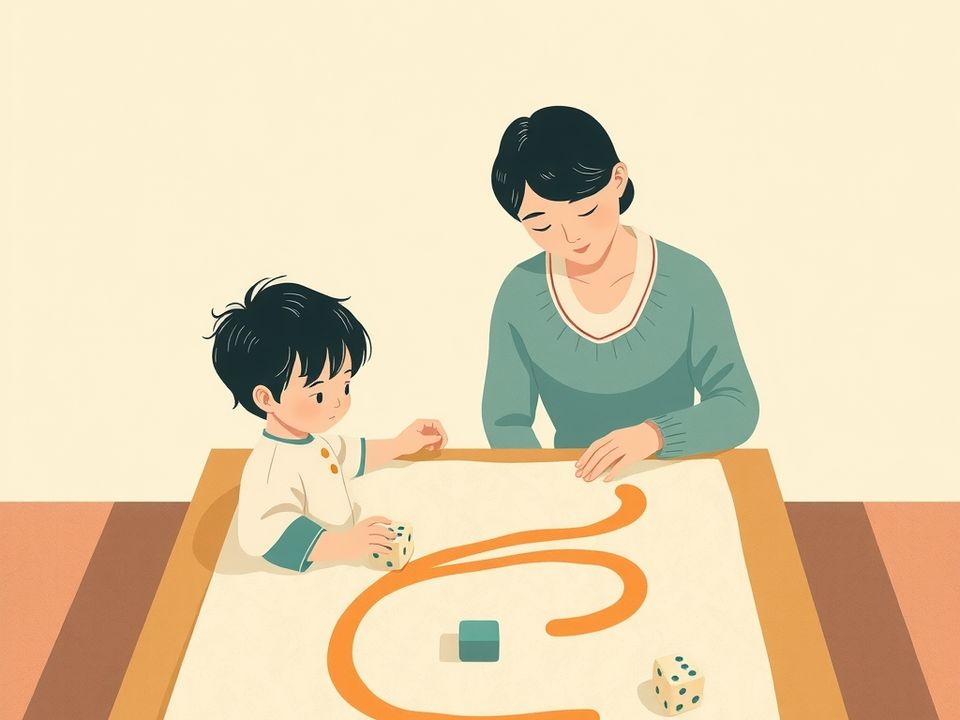
Simple board games are an easy way in. In one study, low-income preschoolers (average age 5.4) who played a board game with numbered squares in a row for roughly 1 hour got better at comparing numbers, placing numbers on a number line, counting and reading numerals, and the gains were still there 9 weeks later. Classmates who played the same game with colored squares instead of numbers did not improve.150 Mixed evidence.
More broadly, a meta-analysis of 64 studies found that children whose home math environment was richer (math activities, but also attitudes, expectations and talk about math at home) tended to have higher math achievement (r = .13), with large differences between studies.133
- Count stairs, share snacks out fairly, compare prices at the store.
- Cook together and let your child do the measuring.
- Play dice games, dominoes and card games such as “higher or lower”.
First homework
Whether your child gets homework at this age depends on the school. If they do, aim for a calm habit, not perfect pages. In a review of US homework research, correlational studies found a weaker link between homework and achievement in kindergarten to grade 6 than in grades 7-12, and all the studies had design flaws.113
The kind of help matters. When parents of elementary school children were trained in how to support homework, children completed more of it, had fewer homework problems and possibly did better at school.124 Across 448 studies, most kinds of parent involvement, such as talking about school or going to school events, had small positive links with children’s achievement, engagement and motivation, varying little with age. The one exception was homework help, which went with lower achievement.111 That is a correlation: it cannot show whether help lowers achievement or whether children who are struggling simply get more help.
- Same time and place each day, after a snack.
- Sit nearby, help your child get started, then step back.
- When they are stuck, ask what they have tried before you explain.
- If homework often ends in tears or takes much longer than the teacher expects, talk to the teacher.
See also Homework for battles in the moment, and homework at 7-10.
Remembering what they learn
Quizzing helps even young children remember. In an experiment with first and third graders learning lists of words, adding a test to restudying led to better memory than restudying alone, even for first graders. Only the third graders realized that the testing had helped.145 So at this age it is up to you to turn practice into a game.
Spacing practice out helps too. In two experiments with preschool children learning names for toys, practice that asked children to recall the names at gradually longer gaps doubled what they remembered, and about half of the benefit came from the spacing itself. Offering a reward did not significantly improve learning.138
- Cover the word or the sum, ask your child to say it, then check together.
- For spelling words or new characters, have your child write them from memory, then check. Dictation counts too.
- Do a few minutes on several days rather than one long session.
Praise that helps
Describe what your child did: the effort, the strategy, the checking, the not giving up. In two small role-play studies with 5- and 6-year-olds, children who received person feedback (praise or criticism of themselves or their traits) reacted more helplessly to a later setback, including blaming themselves, than children who received feedback about the process.38 Mixed evidence. In a study that observed 53 families at home, parents’ praise for effort at ages 1-3 predicted children’s belief at 7-8 that ability can grow, while praise for inborn traits was not linked to later beliefs that ability is fixed.140 Mixed evidence.
So describing the process is the safer habit. The evidence that praising traits does harm comes mainly from short experiments.
You tried three different ways before that one worked.
You checked every answer. That was careful work.
Growth mindset programs have shown weak effects on achievement overall (see growth mindset).153 Mixed evidence. For everyday praise, see Specific praise and attention.
Motivation and rewards
Choices help. A meta-analysis of 41 studies found that being given choices raised intrinsic motivation, effort and performance, and the boost to motivation was stronger for children than for adults and when people made a few (2 to 4) choices in a row.46 Let your child choose which book to read or which task to do first.
Rewards need more care. In a classic experiment, children who already liked an activity and agreed to do it for a promised reward later showed less interest in it than children who got a surprise reward or none.143 Two meta-analyses disagree about how widespread that harm is.134131 Mixed evidence. Both found harm from promised, tangible rewards for tasks people already found interesting, and positive effects from verbal praise, though one found that tangible rewards tended to do more harm, and praise less good, for children than for college students, and the other found that rewards tied to the level of performance did not lower motivation.134131
In practice: no stickers or money for reading, drawing or anything else your child already enjoys. Warm, specific feedback is fine. See also Offering choices.
Focus and self-control
Waiting for a turn, keeping instructions in mind and switching from play to work rely on what psychologists call executive functions. A review names three core ones (self-control, working memory and mental flexibility) and notes that stress, lack of sleep, loneliness and lack of exercise each impair them.72
Many activities can strengthen them. A review of programs for children aged 4-12 found gains from computer training, games, aerobic exercise, martial arts, yoga, mindfulness and some school curricula. The successful ones all involved repeated practice that grew harder over time, and children with weaker skills gained most.135 Mixed evidence. A later series of meta-analyses (children up to 12) found that these skills can be fostered, but found no convincing evidence that the gains last; approaches that build them indirectly worked as well as or better than drills, were more enjoyable and fit more easily into everyday life.155 Mixed evidence.
- Play games that ask for waiting and switching: Simon Says, Red Light Green Light, memory cards.
- Pick activities your child enjoys that take regular practice and slowly get harder, such as a sport, dance, music or martial arts. You do not need brain-training apps.
Sleep and screens
The American Academy of Sleep Medicine, in a statement endorsed by the American Academy of Pediatrics (AAP), recommends 10-13 hours of sleep in every 24 hours for children aged 3-5 and 9-12 hours for ages 6-12, and links getting enough sleep regularly with better attention, behavior, learning, memory and emotional regulation.123
The AAP’s 2016 statement on young children and media, which covers ages 0 to 5, recommended screen-free meals and no screens in the hour before bed, and, for children aged 2 to 5, no more than 1 hour a day of high-quality programs, shared with a parent.110 In a systematic review of 67 studies of school-aged children and teenagers, 90% linked screen time with worse sleep, mostly shorter sleep and later bedtimes, though cause and effect was not confirmed.117
- Keep the same bedtime on school nights, with a short routine: bath, teeth, a book, lights out.
- Watch together when you can, and talk about what you see.
More help: Bedtime battles and Screens.
Sources
The small numbers in the text point to these sources. Each one has a full entry on the Research page.
- Kamins, M. L., & Dweck, C. S. (1999). Person versus process praise and criticism: Implications for contingent self-worth and coping. Developmental Psychology, 35(3), 835-847. See it on the Research page doi:10.1037/0012-1649.35.3.835 Back to the text
- Patall, E. A., Cooper, H., & Robinson, J. C. (2008). The effects of choice on intrinsic motivation and related outcomes: A meta-analysis of research findings. Psychological Bulletin, 134(2), 270-300. See it on the Research page doi:10.1037/0033-2909.134.2.270 Back to the text
- Diamond, A. (2013). Executive Functions. Annual Review of Psychology, 64(1), 135-168. See it on the Research page doi:10.1146/annurev-psych-113011-143750 Back to the text
- American Academy of Pediatrics, Council on Communications and Media (2016). Media and Young Minds. Pediatrics, 138(5), e20162591. See it on the Research page doi:10.1542/peds.2016-2591 Back to the text
- Barger, M. M., Kim, E. M., Kuncel, N. R., & Pomerantz, E. M. (2019). The relation between parents’ involvement in children’s schooling and children’s adjustment: A meta-analysis. Psychological Bulletin, 145(9), 855-890. See it on the Research page doi:10.1037/bul0000201 Back to the text
- Cooper, H., Robinson, J. C., & Patall, E. A. (2006). Does Homework Improve Academic Achievement? A Synthesis of Research, 1987-2003. Review of Educational Research, 76(1), 1-62. See it on the Research page doi:10.3102/00346543076001001 Back to the text
- Hale, L., & Guan, S. (2015). Screen time and sleep among school-aged children and adolescents: A systematic literature review. Sleep Medicine Reviews, 21, 50-58. See it on the Research page doi:10.1016/j.smrv.2014.07.007 Back to the text
- Paruthi, S., et al. (2016). Recommended Amount of Sleep for Pediatric Populations: A Consensus Statement of the American Academy of Sleep Medicine. Journal of Clinical Sleep Medicine, 12(6), 785-786. See it on the Research page doi:10.5664/jcsm.5866 Back to the text
- Patall, E. A., Cooper, H., & Robinson, J. C. (2008). Parent Involvement in Homework: A Research Synthesis. Review of Educational Research, 78(4), 1039-1101. See it on the Research page doi:10.3102/0034654308325185 Back to the text
- Cameron, J., Banko, K. M., & Pierce, W. D. (2001). Pervasive negative effects of rewards on intrinsic motivation: The myth continues. The Behavior Analyst, 24(1), 1-44. See it on the Research page doi:10.1007/bf03392017 Back to the text
- Daucourt, M. C., Napoli, A. R., Quinn, J. M., Wood, S. G., & Hart, S. A. (2021). The home math environment and math achievement: A meta-analysis. Psychological Bulletin, 147(6), 565-596. See it on the Research page doi:10.1037/bul0000330 Back to the text
- Deci, E. L., Koestner, R., & Ryan, R. M. (1999). A meta-analytic review of experiments examining the effects of extrinsic rewards on intrinsic motivation. Psychological Bulletin, 125(6), 627-668. See it on the Research page doi:10.1037/0033-2909.125.6.627 Back to the text
- Diamond, A., & Lee, K. (2011). Interventions Shown to Aid Executive Function Development in Children 4 to 12 Years Old. Science, 333(6045), 959-964. See it on the Research page doi:10.1126/science.1204529 Back to the text
- Fritz, C. O., Morris, P. E., Nolan, D., & Singleton, J. (2007). Expanding retrieval practice: An effective aid to preschool children’s learning. Quarterly Journal of Experimental Psychology, 60(7), 991-1004. See it on the Research page doi:10.1080/17470210600823595 Back to the text
- Gunderson, E. A., Gripshover, S. J., Romero, C., Dweck, C. S., Goldin-Meadow, S., & Levine, S. C. (2013). Parent Praise to 1- to 3-Year-Olds Predicts Children’s Motivational Frameworks 5 Years Later. Child Development, 84(5), 1526-1541. See it on the Research page doi:10.1111/cdev.12064 Back to the text
- Kim, J. S., & Quinn, D. M. (2013). The Effects of Summer Reading on Low-Income Children’s Literacy Achievement From Kindergarten to Grade 8: A Meta-Analysis of Classroom and Home Interventions. Review of Educational Research, 83(3), 386-431. See it on the Research page doi:10.3102/0034654313483906 Back to the text
- Lepper, M. R., Greene, D., & Nisbett, R. E. (1973). Undermining children’s intrinsic interest with extrinsic reward: A test of the “overjustification” hypothesis. Journal of Personality and Social Psychology, 28(1), 129-137. See it on the Research page doi:10.1037/h0035519 Back to the text
- Lipowski, S. L., Pyc, M. A., Dunlosky, J., & Rawson, K. A. (2014). Establishing and explaining the testing effect in free recall for young children. Developmental Psychology, 50(4), 994-1000. See it on the Research page doi:10.1037/a0035202 Back to the text
- Mol, S. E., & Bus, A. G. (2011). To read or not to read: A meta-analysis of print exposure from infancy to early adulthood. Psychological Bulletin, 137(2), 267-296. See it on the Research page doi:10.1037/a0021890 Back to the text
- Ramani, G. B., & Siegler, R. S. (2008). Promoting Broad and Stable Improvements in Low-Income Children’s Numerical Knowledge Through Playing Number Board Games. Child Development, 79(2), 375-394. See it on the Research page doi:10.1111/j.1467-8624.2007.01131.x Back to the text
- Sisk, V. F., Burgoyne, A. P., Sun, J., Butler, J. L., & Macnamara, B. N. (2018). To What Extent and Under Which Circumstances Are Growth Mind-Sets Important to Academic Achievement? Two Meta-Analyses. Psychological Science, 29(4), 549-571. See it on the Research page doi:10.1177/0956797617739704 Back to the text
- Takacs, Z. K., & Kassai, R. (2019). The efficacy of different interventions to foster children’s executive function skills: A series of meta-analyses. Psychological Bulletin, 145(7), 653-697. See it on the Research page doi:10.1037/bul0000195 Back to the text