The best-proven approach
Four well-known parenting programs (PCIT, Triple P, Incredible Years and PMTO) share a common behavioral core, which this page sums up as five skills: warm attention for the behavior you want, clear instructions, ignoring the small stuff, brief calm consequences, and following through. Here is how to do each one, the research behind it, and what to do when it gets hard.
Start here
- Give your child 5 to 10 minutes of one-on-one play every day this week (connection time). Let them lead, and skip questions, teaching and corrections.
- Catch your child being good several times a day and say what you liked: “You put your cup in the sink. Thank you!” (specific praise)
- Give clear instructions: get close, say one thing to do as a statement, not a question, then wait quietly for about 5 seconds.
- Pick one small attention-seeking habit, such as whining, to ignore calmly (planned ignoring), and praise the opposite the moment you see it.
- Hold off on new punishments for a week or two. Build up the positive side first, then add one brief, calm consequence (see the plan).
Why this approach
Parent training has been tested so often that one study pooled 26 meta-analyses of it: for children under 13 treated for behavior problems, the effect on behavior was moderate and held up at follow-up.23 In 36 controlled trials with young children (average age 4.7), behavioral treatments for disruptive behavior had the largest effects, and the authors concluded that psychosocial treatments such as these should be the first-line treatment for early disruptive behavior problems.3 Cochrane reviews found that group programs reduced conduct problems in 3- to 12-year-olds and improved parents’ mental health,8 and found evidence of fewer emotional and behavioral problems in children under 4.1
Effects grow with need: smallest when a program is offered to every family, largest when children are in treatment for clear problems.16 The review of 26 meta-analyses found that gains held up at follow-up,23 but another meta-analysis found only small effects at follow-up,20 so keep the habits going.
What makes these programs work? Across 77 evaluations of programs for children up to age 7, effects were larger when programs taught positive interaction and emotional communication, taught time-out and consistency, and had parents practice with their own child during sessions; teaching parents problem solving, or how to promote children’s academic or social skills, went with smaller effects.11 Of 26 techniques examined in another analysis, only 3 were linked with stronger effects: positive reinforcement, praise in particular, and natural or logical consequences.16
The change can start with you: in a trial with divorcing mothers of sons in grades 1 to 3, the program helped the boys through their mothers’ improved parenting, not directly.6 The approach has also been tested with Chinese families,1017 and school age is not too late: two large meta-analyses, one covering 156 trials, found no evidence that programs worked better when children started younger.9
The five core skills
The five skills work as a set: 2 for the behavior you want, 2 for the behavior you don’t, and 1 that holds it all together. This page starts with warm attention and adds consequences later.
Warm attention and specific praise
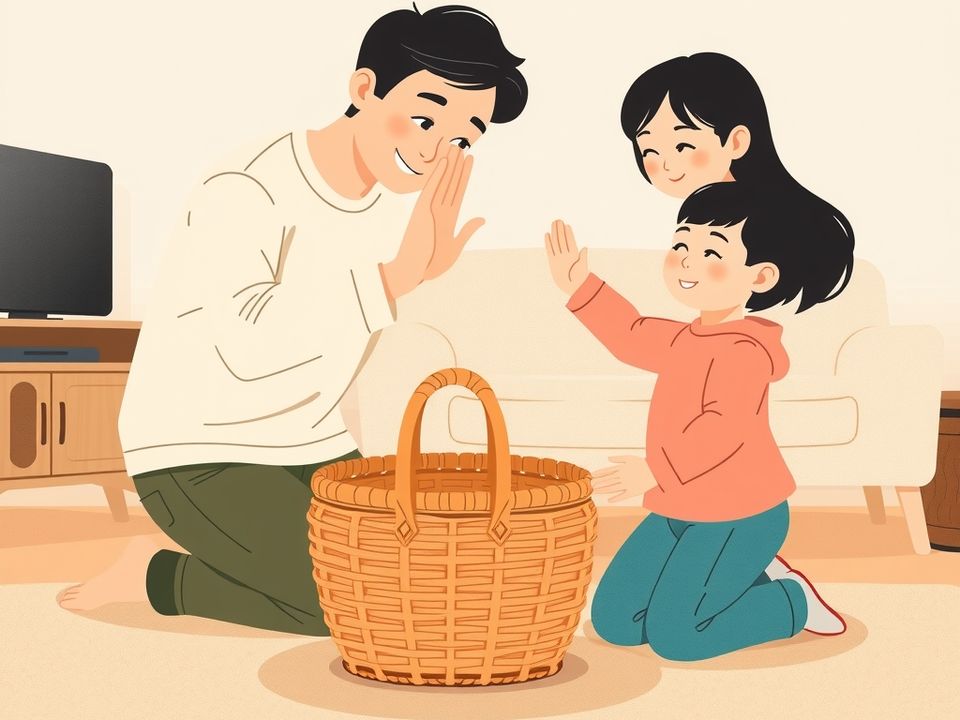
What to do. Notice the behavior you want and respond warmly: a smile, a touch, a few words. Several times a day, say exactly what you liked (specific praise). If you can, add 5 to 10 minutes a day of one-on-one play where your child leads, with no questions, instructions or criticism (connection time).
Example. Your child is drawing quietly while you cook. Walk over: “You’ve been drawing so calmly. I love the colors in that sky.”
You put your shoes away without being asked. Thank you!
You’re building a really tall tower. Now the red block goes on top.
The evidence. Programs that build positive interaction have larger effects,11 and praise is one of the few techniques linked with stronger results.16 In treatment for behavior problems, adding relationship building to behavior management worked better than behavior management alone; in prevention programs it did worse, and there was no difference in effects lasting up to 3 years.15 But praise does not buy obedience on the spot: on its own, it did not reliably increase compliance.4045 And wording matters less than you might think: in two experiments with 3- to 9-year-olds, naming the behavior worked no better than a plain “Well done!”41
Clear instructions
What to do. Give fewer instructions, and make each one count (clear expectations and instructions). Get close and get your child’s attention. Say one thing, as a statement, and say what to do rather than what to stop: “Feet on the floor, please,” not “Stop jumping!” Wait quietly for about 5 seconds. If your child starts, praise it; if not, give one warning and follow through. For a task your child dislikes, use when-then.
Example. Instead of calling “Can you get ready?” from the kitchen, walk over, crouch down and say, “Time to put your shoes on.” Then wait.
Shoes on now, please.
When the blocks are in the box, then you can have your snack.
The evidence. A review of 42 studies concluded that delivering instructions effectively, and opening with a few easy requests before a harder one, may be considered evidence-based ways to increase cooperation.47 In PCIT trials, observers saw children follow their parents’ requests more than children in control groups did.28
Planned ignoring of minor misbehavior
What to do. Some behavior is mostly a bid for attention: whining, fake crying, silly noises. Pick 1 or 2. When they happen, look away, stay calm and say nothing (planned ignoring). The moment the behavior stops, turn back warmly. If it gets louder at first, hold steady: giving in at that point is the one thing to avoid. Never ignore hitting, breaking things or anything dangerous.
Example. Your child whines, “I want juice nowww.” You keep folding laundry. When they ask in a normal voice, you turn right away: “Thanks for asking nicely. Sure.”
I’ll listen when you use your regular voice.
That’s your regular voice. Thank you. What would you like?
The evidence. In experiments that tested single parenting behaviors, briefly ignoring a child after they did not cooperate reliably increased cooperation.40 Pair it with plenty of attention for the behavior you want. More in Whining.
Brief, calm consequences
What to do. For behavior you cannot ignore, such as hitting, breaking a rule you have explained, or refusing an important instruction after a warning, use a brief consequence, the same way every time:
- A time-out: a few minutes in a dull spot away from toys, screens and attention, then a fresh start with no lecture.
- A privilege removal: losing something small for a short, set time, such as the tablet this evening.
- A logical consequence: one tied to the behavior, such as a ball thrown indoors going on a shelf until after dinner.
Then go back to warm attention. With babies, move the baby or the object instead (see Babies).
Example. Your child throws a block at their sister. “No throwing. Time-out.” A few minutes later: “Time-out is over.” No lecture.
If you throw the ball inside again, it goes on the shelf until after dinner.
You threw it again, so the ball goes on the shelf. You can have it after dinner.
The evidence. Programs that teach time-out and consistency have larger effects,11 time-out for not cooperating reliably increased cooperation in experiments,40 and natural and logical consequences are among the few techniques linked with stronger results.16 Some critics worry that time-out harms children’s sense of security. A long-term study found that using it at age 3 was not linked with any later difference in emotional, behavioral or relationship outcomes,39 and reviews conclude that careful use is justified and generally good for children.4330 On length, see a short time-out.
Consistent follow-through
What to do. Do what you said you would do, calmly, every time. Give only instructions you will back up, one warning rather than a string of them, and let a time-out run its full length. Keep promises about good things too. It helps when every adult does the same (see when caregivers disagree).
Example. “Two more slides, then we go home.” After the second slide, you go, even if there are tears. Stay kind and brief: “It’s hard to leave. We’ll come back on Saturday.”
Pajamas are on, so it’s story time.
That was the last slide. You can walk with me, or I can carry you.
The evidence. Teaching time-out together with the importance of consistency is one of the ingredients linked with larger program effects.11 In a small clinic study of time-out with preschoolers, the researchers concluded that enforcing a minimum time-out length was critical for teaching cooperation.31
Getting started: the first weeks
This takes real effort: you are changing your own habits while tired and busy, and it will feel awkward for a while. A simple plan:
- Week 1: attention first. Daily one-on-one play and lots of praise, with no new punishments. Note 2 or 3 behaviors you want more of and 1 or 2 you want less of, and tell the other adults who care for your child.
- Week 2: instructions and ignoring. Fewer, clearer instructions, when-then, and ignoring one minor behavior.
- Week 3: one consequence. Use it for 1 or 2 behaviors, such as hitting. Explain it at a calm time, practice it once (a teddy bear works), then use it every time.
- After that: keep going. Keep up the play and praise even when things improve.
Practice matters: programs in which parents practiced with their own child had larger effects,11 and PCIT studies that required parents to reach a set skill level found bigger improvements.28 It helps you too: parents’ mental health improved,8 and parenting stress went down.28 If nothing changes after several weeks of steady effort, see when it is not working.
The four programs
You do not need to enroll in a program to use these skills, but the names tell you what to ask for.
- PCIT (Parent-Child Interaction Therapy). A therapist coaches the parent while parent and child play together. Across 23 studies, it reduced children’s behavior problems and parents’ stress.28
- Triple P (Positive Parenting Program). A multi-level system, from light-touch media formats to more intensive group and individual programs. Across 101 studies with more than 16,000 families, it had short- and long-term benefits for children and parents.27
- Incredible Years. Often run with groups of parents. Across 50 studies, it reduced disruptive behavior, more so for children with more serious problems.21
- PMTO (Parent Management Training, Oregon model). Parents learn to encourage skills, set limits, supervise, solve problems and stay positively involved. It has been tested across settings, cultures and formats.7
What this means for you. The core is shared, so you can start with this page. There is no clear evidence that programs lose their effect in ordinary services with non-specialist therapists,22 and no single way of delivering them has been shown to be best,5 so choose what fits your family. Look for a program if behavior is severe, is not improving, or causes problems at school too. If money is tight, ask about one-on-one sessions: in one meta-analysis, families facing economic hardship gained significantly more from individual than from group programs.20
Evidence from Chinese families
Does an approach developed in the West fit a Chinese family? It has been tested:
- Shanghai. In a randomized trial with 81 parents, Group Triple P parents reported fewer child adjustment problems, better parenting, better well-being and more confidence than a wait-list group, plus more satisfaction with their children’s academic achievement and fewer academic problem behaviors, all lasting to 6 months.10
- Hong Kong. In a randomized trial with 91 parents of 3- to 7-year-olds with early conduct problems, parents who took Triple P reported fewer child behavior problems, less dysfunctional parenting and more confidence than a wait-list group.17
- Hong Kong, PCIT. Families of children with significant behavior problems who received PCIT (48 families) reported fewer behavior problems and less parenting stress than a comparison group (62 families). Observers saw more positive parenting, and the changes generally lasted 3 to 6 months.18
- ADHD. In a randomized trial with 64 Chinese children with ADHD or ADHD features, PCIT reduced behavior and attention problems, parenting stress and negative parenting.19
These studies are smaller than the big Western reviews, and several rely on parents’ own reports, so read them as encouraging rather than final. If praising out loud feels awkward because you grew up with little of it, start with one specific comment a day.
Edge cases
Real life is messier than any plan. Here is how the same skills apply in common hard spots, and when to get professional help.
Your child refuses or leaves time-out
Stay calm and keep it boring.
- Give one calm warning with a back-up (“If you get up again, no tablet tonight”), then follow through without arguing.
- Use few words and a flat voice. Arguing or chasing turns time-out into attention.
- Make going straight away pay off. In a small study, shortening time-out for boys who went when told helped 4 of the 6 go when asked.33
- Don’t wait for silence. In two very small studies, both kinds of time-out worked: ones that simply ended on time, and ones that waited for the child to be quiet.3242
- Keep back-ups calm and non-physical; never lock a child in or hold them down. In a small clinic study of preschoolers who left time-out, a back-up that did not involve spanking (a “barrier” procedure) worked as well as spanking, and the researchers concluded that enforcing a minimum time-out length was the critical part.31 For the wider research debate, see what the studies found.
Time-out is over. Let’s try again: blocks in the box, please.
Get help if time-out turns into a daily battle, or you notice yourself getting rough. A therapist, for example in a program such as PCIT, can coach you through this moment.
Hitting and other aggression
Some hitting, biting and pushing is part of early childhood. Physical aggression shows up by 12 months, rises between ages 1 and 2, and declines from about the third birthday.67 In a large Canadian study, most children were physically aggressive only rarely or almost never by the preteen years, while about 1 in 6 stayed at a high level.71
- Stop it at once, calmly: step in, block, or separate the children.
- Tend to the hurt child first.
- Use the same brief consequence every time, such as time-out or losing the toy.
- Later, practice what to do instead (say “Stop!”, walk away, or come and get you), and praise gentle play.
No hitting. Hitting hurts. Time-out.
If he grabs your truck, you can say ‘Stop, that’s mine!’ and come and get me.
Behavioral treatments for young children, PCIT among them, reduce externalizing behavior, a research term that includes aggression.328 In a small classroom study of 4 aggressive preschoolers, aggression dropped substantially when teachers took away a smiley face, with a reprimand, for each aggressive act, and children who kept at least one face chose a reward.48 More in Hitting and biting.
Get help if aggression is frequent or severe, causes injuries, happens at preschool or school too, or is not easing as your child gets older. In one study, preschoolers with disruptive behavior disorders were more often violent during tantrums, had more tantrums at school or daycare, and had a harder time recovering than healthy children.69
In public places
- Before you go in, set the rule and the reward with a when-then.
- Go when your child is fed and rested, and bring something to do.
- Praise good behavior often while you are out.
- Ignore minor fussing. For bigger problems, give one warning, then use a consequence you can carry out: a short time-out in a quiet corner, a few minutes in the car with you, or losing the promised treat.
- If you need to leave, leave calmly. Consistency matters more than onlookers.
In the store, we walk next to the cart. When we’re done, you can choose the apples.
The research here is about the core skills in general, not public places in particular. More in Public meltdowns.
Get help if outings are regularly impossible, or your child often runs off into danger (see dangerous behavior).
Siblings
- Catch them getting along: “You two are taking turns so nicely.”
- Keep a few clear rules, such as no hitting and ask before taking. Hitting gets the usual consequence; if you didn’t see who started it, both take a short break.
- For everyday squabbles, coach rather than judge: each child says what happened and how they feel, then they suggest fixes.
- Give each child some one-on-one time.
You both want the blue cup. Tell me what happened, one at a time. Then let’s find a fix you both like.
When mothers of 5- to 8-year-olds were trained to mediate their children’s disputes, children reasoned and talked about feelings more often than in control families, and younger siblings especially became better able to solve conflicts, at least in the short term.49 In a study of 95 families, a program that taught 4- to 8-year-old siblings emotional and social skills also improved their relationships, compared with families on a waiting list.82 Take sibling aggression seriously: children aged 0 to 9 who had experienced it in the past year showed more mental health distress.103 More in Sibling fighting.
Get help if one child is often hurt, frightened or singled out.
When caregivers disagree
- Talk it over away from your child, when you are both calm.
- Agree on 2 or 3 house rules and the consequence for each. A family rules poster can help.
- Don’t overrule each other in front of your child unless something is unsafe; talk about it later.
Let’s talk about this tonight.
In a meta-analysis of 59 studies, cooperation, agreement and conflict between parents were associated with children’s adjustment; the effects were small, but they held after accounting for each parent’s own parenting or for the quality of their marriage.100
Get help if disagreements turn into frequent fights, or one adult’s discipline becomes harsh. A parenting program together, or couples counseling, is worth considering.
When grandparents do the caregiving
- Start with thanks, and ask rather than instruct.
- Share the 2 or 3 things that matter most to you, such as praise for helping and the same response to hitting, and let smaller differences go.
- Show rather than tell: let them see you praise and use time-out, or share this page.
Thank you for everything you do with them. We’re trying something new: praising them right away when they do something well. Would you try it with us?
In a randomized trial with 54 grandparents caring for 2- to 9-year-olds, Grandparent Triple P reduced the behavior problems grandparents reported, raised their confidence, eased their stress, anxiety and depression, and improved their relationship with the child’s parents, who also reported fewer behavior problems without attending.13 More in Grandparents with different rules.
Get help if disagreements cause lasting tension between the generations. A family session with a counselor is worth considering.
Dangerous behavior
Running into the road, climbing onto a windowsill, reaching for the stove: act first, teach later.
- Stop it physically and calmly: take the hand, pick your child up, move them away. Using your body to keep a child safe is right at any age (see how to step in physically, calmly).
- Make it hard to happen again: close supervision, gates, locks, and dangerous things out of reach.
- Set one clear rule with a consequence, and practice it, such as stopping at the curb together.
- Never use planned ignoring for anything dangerous.
Hand, please. In the parking lot, we hold hands or ride in the cart.
Preschoolers with depression showed more self-harming behavior during tantrums than healthy children,69 so a young child who hurts themselves on purpose needs a professional’s attention, not only discipline.
If your child hurts themselves on purpose, hurts animals or plays with fire, or you cannot keep everyone safe, contact a doctor or mental health professional promptly. If someone is in immediate danger, call your local emergency number. Help lines are on the About page.
ADHD, autism and other developmental differences
The core skills help children with ADHD and autism too, though results differ by outcome.
- ADHD. In a meta-analysis of 32 randomized trials of behavioral approaches for ADHD, ratings by people who probably did not know which families had the program still showed better parenting and fewer conduct problems, but those blinded ratings did not show fewer ADHD symptoms.4 For preschoolers with ADHD or its symptoms, parents reported moderate improvements in symptoms and behavior lasting 3 to 12 months, but independent assessments confirmed only the drop in negative parenting.26
- Autism. Across 8 randomized trials, parent training reduced disruptive behavior in children with autism, though results varied a lot between studies.24 In a trial with 180 children aged 3 to 7, parent training reduced parent-reported disruptive behavior more than general autism education did, though how much that matters clinically is unclear.2
Helpful adjustments: very short instructions, pictures and visual schedules, quicker and more frequent praise, and small steps.
Ask your child’s doctor about a developmental assessment if attention, activity or impulsiveness cause problems in more than one place, such as home and school; if you worry about how your child talks, plays or relates to others; or if your child loses words or skills.
In a 2020 clinical report, the American Academy of Pediatrics recommended autism screening at 18 and 24 months and noted that autism can be diagnosed as young as 18 months.79 Revised US milestone checklists list skills that most children (75% or more) reach by each checkup age, so a missed milestone is a reason to ask, not a diagnosis.109 For ADHD, the AAP’s 2019 guideline added a recommendation on diagnosing and treating conditions that occur alongside it.107
You don’t need to wait for an assessment to start using the skills on this page.
Preteens: more say, same core
From about 10, the approach stays the same but the balance shifts: more listening and negotiation, fewer orders, consequences agreed in advance. Across 1,435 studies, warmth, clear behavioral limits and granting autonomy had small links with fewer behavior problems, while harsh control and psychological control (guilt, shaming, withdrawing love) had the strongest links with more.91 Sixth and seventh graders who saw no growing part in family decisions turned more sharply toward peers,77 and in a study of 14-year-olds, what parents knew about their children’s lives came mainly from what the children chose to tell them, not from checking up.95 Keep praise specific and private, swap time-out for short privilege removal, and take recurring fights to a weekly family meeting. The Preteens page has the detail.
When it is not working after several weeks
Give a new plan a few weeks of steady effort before you judge it. Then check:
- Consistency. Do you follow through every time, and do all the adults do the same?
- Positive attention. Is there daily one-on-one time? Do you praise more than you correct? If you are not sure, count for an hour.
- Commands. Count your instructions for an hour, too. Drop the unneeded ones, and make the rest clear.
- The consequence. Is time-out really dull, with no chatting, toys or screens? Is the consequence small enough to use every time?
- Your own stress and support. Exhaustion, low mood, money worries or conflict with a partner make every skill harder. In a meta-analysis, results depended partly on things outside the child: low family income was the strongest predictor, and parents’ education, mothers’ mental health and how severe the problems were also mattered.25 Support for you is part of the plan.
- Something else. A new baby, a move, a new school, poor sleep or illness can all show up as behavior.
For children aged 7 to 14 with oppositional defiant disorder, Collaborative & Proactive Solutions, in which adults and the child work out problems together, worked as well as parent management training in a randomized trial.44 See Solving problems together.
Get help if things are no better after a month or two of steady effort, the behavior is severe or dangerous, problems also show up at school, or you feel out of control. Parent training helps most where problems are most serious,16 so a program with a therapist is worth seeking when home efforts are not enough.
When to get professional help
Look for a parent-training program or a professional if:
- behavior problems are frequent and intense, last for months, or happen at preschool or school too;
- tantrums happen every day, or are very long, unpredictable or destructive (most preschoolers have tantrums sometimes, but only 8.6% had them daily in one large study);105
- your child hurts other people, animals or themselves;
- you are worried about your child’s development, attention or social skills;
- you feel close to losing control, or worry about how discipline is going at home (see warning signs that discipline has become abuse);
- your own mood, sleep or stress is getting in the way.
Start with your child’s doctor, and ask for behavioral parent training such as PCIT, Triple P, Incredible Years or PMTO, or a therapist who uses the same skills. A good sign: you practice with your own child and get feedback, not just listen to talks. Programs in which parents practiced with their own child during sessions had larger effects.11
If someone is in danger right now, call your local emergency number. Help lines are listed on the About page.
Sources
The small numbers in the text point to these sources. Each one has a full entry on the Research page.
- Barlow, J., Bergman, H., Kornør, H., Wei, Y., & Bennett, C. (2016). Group-based parent training programmes for improving emotional and behavioural adjustment in young children. Cochrane Database of Systematic Reviews. See it on the Research page doi:10.1002/14651858.cd003680.pub3 Back to the text
- Bearss, K., Johnson, C., Smith, T., Lecavalier, L., Swiezy, N., Aman, M., McAdam, D. B., Butter, E., Stillitano, C., Minshawi, N., Sukhodolsky, D. G., Mruzek, D. W., Turner, K., Neal, T., Hallett, V., Mulick, J. A., Green, B., Handen, B., Deng, Y., . . . Scahill, L. (2015). Effect of Parent Training vs Parent Education on Behavioral Problems in Children With Autism Spectrum Disorder: A Randomized Clinical Trial. JAMA, 313(15), 1524. See it on the Research page doi:10.1001/jama.2015.3150 Back to the text
- Comer, J. S., Chow, C., Chan, P. T., Cooper-Vince, C., & Wilson, L. A. S. (2013). Psychosocial Treatment Efficacy for Disruptive Behavior Problems in Very Young Children: A Meta-Analytic Examination. Journal of the American Academy of Child & Adolescent Psychiatry, 52(1), 26-36. See it on the Research page doi:10.1016/j.jaac.2012.10.001 Back to the text
- Daley, D., van der Oord, S., Ferrin, M., Danckaerts, M., Doepfner, M., Cortese, S., & Sonuga-Barke, E. J. S. (2014). Behavioral Interventions in Attention-Deficit/Hyperactivity Disorder: A Meta-Analysis of Randomized Controlled Trials Across Multiple Outcome Domains. Journal of the American Academy of Child & Adolescent Psychiatry, 53(8), 835-847.e5. See it on the Research page doi:10.1016/j.jaac.2014.05.013 Back to the text
- Dretzke, J., Davenport, C., Frew, E., Barlow, J., Stewart-Brown, S., Bayliss, S., Taylor, R. S., Sandercock, J., & Hyde, C. (2009). The clinical effectiveness of different parenting programmes for children with conduct problems: a systematic review of randomised controlled trials. Child and Adolescent Psychiatry and Mental Health, 3(1), 7. See it on the Research page doi:10.1186/1753-2000-3-7 Back to the text
- Forgatch, M. S., & DeGarmo, D. S. (1999). Parenting through change: An effective prevention program for single mothers. Journal of Consulting and Clinical Psychology, 67(5), 711-724. See it on the Research page doi:10.1037/0022-006x.67.5.711 Back to the text
- Forgatch, M. S., & Kjøbli, J. (2016). Parent Management Training-Oregon Model: Adapting intervention with rigorous research. Family Process, 55(3), 500-513. See it on the Research page doi:10.1111/famp.12224 Back to the text
- Furlong, M., McGilloway, S., Bywater, T., Hutchings, J., Smith, S. M., & Donnelly, M. (2012). Behavioural and cognitive-behavioural group-based parenting programmes for early-onset conduct problems in children aged 3 to 12 years. Cochrane Database of Systematic Reviews, 2012(2). See it on the Research page doi:10.1002/14651858.cd008225.pub2 Back to the text
- Gardner, F., Leijten, P., Melendez-Torres, G. J., Landau, S., Harris, V., Mann, J., Beecham, J., Hutchings, J., & Scott, S. (2019). The earlier the better? Individual participant data and traditional meta-analysis of age effects of parenting interventions. Child Development, 90(1), 7-19. See it on the Research page doi:10.1111/cdev.13138 Back to the text
- Guo, M., Morawska, A., & Sanders, M. R. (2016). A randomized controlled trial of Group Triple P with Chinese parents in Mainland China. Behavior Modification, 40(6), 825-851. See it on the Research page doi:10.1177/0145445516644221 Back to the text
- Kaminski, J. W., Valle, L. A., Filene, J. H., & Boyle, C. L. (2008). A Meta-analytic Review of Components Associated with Parent Training Program Effectiveness. Journal of Abnormal Child Psychology, 36(4), 567-589. See it on the Research page doi:10.1007/s10802-007-9201-9 Back to the text
- Kirby, J. N., & Sanders, M. R. (2014). A randomized controlled trial evaluating a parenting program designed specifically for grandparents. Behaviour Research and Therapy, 52, 35-44. See it on the Research page doi:10.1016/j.brat.2013.11.002 Back to the text
- Leijten, P., et al. (2018). Are Relationship Enhancement and Behavior Management “The Golden Couple” for Disruptive Child Behavior? Two Meta-analyses. Child Development, 89(6). See it on the Research page doi:10.1111/cdev.13051 Back to the text
- Leijten, P., Gardner, F., Melendez-Torres, G. J., et al. (2019). Meta-Analyses: Key Parenting Program Components for Disruptive Child Behavior. Journal of the American Academy of Child & Adolescent Psychiatry, 58(2), 180-190. See it on the Research page doi:10.1016/j.jaac.2018.07.900 Back to the text
- Leung, C., Sanders, M. R., Leung, S., Mak, R., & Lau, J. (2003). An outcome evaluation of the implementation of the Triple P-Positive Parenting Program in Hong Kong. Family Process, 42(4), 531-544. See it on the Research page doi:10.1111/j.1545-5300.2003.00531.x Back to the text
- Leung, C., Tsang, S., Heung, K., & Yiu, I. (2009). Effectiveness of Parent-Child Interaction Therapy (PCIT) among Chinese families. Research on Social Work Practice, 19(3), 304-313. See it on the Research page doi:10.1177/1049731508321713 Back to the text
- Leung, C., Tsang, S., Ng, G. S. H., & Choi, S. Y. (2017). Efficacy of Parent-Child Interaction Therapy with Chinese ADHD children: Randomized controlled trial. Research on Social Work Practice, 27(1), 36-47. See it on the Research page doi:10.1177/1049731516643837 Back to the text
- Lundahl, B., Risser, H. J., & Lovejoy, M. C. (2006). A meta-analysis of parent training: Moderators and follow-up effects. Clinical Psychology Review, 26(1), 86-104. See it on the Research page doi:10.1016/j.cpr.2005.07.004 Back to the text
- Menting, A. T. A., Orobio de Castro, B., & Matthys, W. (2013). Effectiveness of the Incredible Years parent training to modify disruptive and prosocial child behavior: A meta-analytic review. Clinical Psychology Review, 33(8), 901-913. See it on the Research page doi:10.1016/j.cpr.2013.07.006 Back to the text
- Michelson, D., Davenport, C., Dretzke, J., Barlow, J., & Day, C. (2013). Do Evidence-Based Interventions Work When Tested in the “Real World?” A Systematic Review and Meta-analysis of Parent Management Training for the Treatment of Child Disruptive Behavior. Clinical Child and Family Psychology Review, 16(1), 18-34. See it on the Research page doi:10.1007/s10567-013-0128-0 Back to the text
- Mingebach, T., Kamp-Becker, I., Christiansen, H., & Weber, L. (2018). Meta-meta-analysis on the effectiveness of parent-based interventions for the treatment of child externalizing behavior problems. PLOS ONE, 13(9), e0202855. See it on the Research page doi:10.1371/journal.pone.0202855 Back to the text
- Postorino, V., Sharp, W. G., McCracken, C. E., Bearss, K., Burrell, T. L., Evans, A. N., & Scahill, L. (2017). A Systematic Review and Meta-analysis of Parent Training for Disruptive Behavior in Children with Autism Spectrum Disorder. Clinical Child and Family Psychology Review, 20(4), 391-402. See it on the Research page doi:10.1007/s10567-017-0237-2 Back to the text
- Reyno, S. M., & McGrath, P. J. (2005). Predictors of parent training efficacy for child externalizing behavior problems - a meta-analytic review. Journal of Child Psychology and Psychiatry, 47(1), 99-111. See it on the Research page doi:10.1111/j.1469-7610.2005.01544.x Back to the text
- Rimestad, M. L., Lambek, R., Zacher Christiansen, H., & Hougaard, E. (2016). Short- and Long-Term Effects of Parent Training for Preschool Children With or at Risk of ADHD: A Systematic Review and Meta-Analysis. Journal of Attention Disorders, 23(5), 423-434. See it on the Research page doi:10.1177/1087054716648775 Back to the text
- Sanders, M. R., Kirby, J. N., Tellegen, C. L., & Day, J. J. (2014). The Triple P-Positive Parenting Program: A systematic review and meta-analysis of a multi-level system of parenting support. Clinical Psychology Review, 34(4), 337-357. See it on the Research page doi:10.1016/j.cpr.2014.04.003 Back to the text
- Thomas, R., Abell, B., Webb, H. J., Avdagic, E., & Zimmer-Gembeck, M. J. (2017). Parent-Child Interaction Therapy: A Meta-analysis. Pediatrics, 140(3), e20170352. See it on the Research page doi:10.1542/peds.2017-0352 Back to the text
- Dadds, M. R., & Tully, L. A. (2019). What is it to discipline a child: What should it be? A reanalysis of time-out from the perspective of child mental health, attachment, and trauma. American Psychologist, 74(7), 794-808. See it on the Research page doi:10.1037/amp0000449 Back to the text
- Day, D. E., & Roberts, M. W. (1983). An analysis of the physical punishment component of a parent training program. Journal of Abnormal Child Psychology, 11(1), 141-152. See it on the Research page doi:10.1007/bf00912184 Back to the text
- Donaldson, J. M., & Vollmer, T. R. (2011). An Evaluation and Comparison of Time-Out Procedures With and Without Release Contingencies. Journal of Applied Behavior Analysis, 44(4), 693-705. See it on the Research page doi:10.1901/jaba.2011.44-693 Back to the text
- Donaldson, J. M., Vollmer, T. R., Yakich, T. M., & Van Camp, C. (2013). Effects of a Reduced Time-Out Interval on Compliance With the Time-Out Instruction: Compliance With Time-Out. Journal of Applied Behavior Analysis, 46(2), 369-378. See it on the Research page doi:10.1002/jaba.40 Back to the text
- Knight, R. M., Albright, J., Deling, L., Dore-Stites, D., & Drayton, A. K. (2020). Longitudinal Relationship Between Time-Out and Child Emotional and Behavioral Functioning. Journal of Developmental & Behavioral Pediatrics, 41(1), 31-37. See it on the Research page doi:10.1097/dbp.0000000000000725 Back to the text
- Leijten, P., Gardner, F., Melendez-Torres, G. J., Knerr, W., & Overbeek, G. (2018). Parenting behaviors that shape child compliance: A multilevel meta-analysis. PLOS ONE, 13(10), e0204929. See it on the Research page doi:10.1371/journal.pone.0204929 Back to the text
- Leijten, P., Thomaes, S., Orobio de Castro, B., Dishion, T. J., & Matthys, W. (2016). What good is labeling what’s good? A field experimental investigation of parental labeled praise and child compliance. Behaviour Research and Therapy, 87, 134-141. See it on the Research page doi:10.1016/j.brat.2016.09.008 Back to the text
- Mace, F. C., Page, T. J., Ivancic, M. T., & O’Brien, S. (1986). Effectiveness of brief time-out with and without contingent delay: A comparative analysis. Journal of Applied Behavior Analysis, 19(1), 79-86. See it on the Research page doi:10.1901/jaba.1986.19-79 Back to the text
- Morawska, A., & Sanders, M. R. (2011). Parental Use of Time Out Revisited: A Useful or Harmful Parenting Strategy?. Journal of Child and Family Studies, 20, 1-8. See it on the Research page doi:10.1007/s10826-010-9371-x Back to the text
- Ollendick, T. H., Greene, R. W., Austin, K. E., Fraire, M. G., Halldorsdottir, T., Allen, K. B., Jarrett, M. A., Lewis, K. M., Whitmore Smith, M., Cunningham, N. R., Noguchi, R. J. P., Canavera, K., & Wolff, J. C. (2015). Parent Management Training and Collaborative & Proactive Solutions: A Randomized Control Trial for Oppositional Youth. Journal of Clinical Child & Adolescent Psychology, 45(5), 591-604. See it on the Research page doi:10.1080/15374416.2015.1004681 Back to the text
- Owen, D. J., Slep, A. M. S., & Heyman, R. E. (2012). The Effect of Praise, Positive Nonverbal Response, Reprimand, and Negative Nonverbal Response on Child Compliance: A Systematic Review. Clinical Child and Family Psychology Review, 15(4), 364-385. See it on the Research page doi:10.1007/s10567-012-0120-0 Back to the text
- Radley, K. C., & Dart, E. H. (2016). Antecedent Strategies to Promote Children’s and Adolescents’ Compliance with Adult Requests: A Review of the Literature. Clinical Child and Family Psychology Review, 19, 39-54. See it on the Research page doi:10.1007/s10567-015-0197-3 Back to the text
- Reynolds, L. K., & Kelley, M. L. (1997). The efficacy of a response cost-based treatment package for managing aggressive behavior in preschoolers. Behavior Modification, 21(2), 216-230. See it on the Research page doi:10.1177/01454455970212005 Back to the text
- Siddiqui, A., & Ross, H. (2004). Mediation as a Method of Parent Intervention in Children’s Disputes. Journal of Family Psychology, 18(1), 147-159. See it on the Research page doi:10.1037/0893-3200.18.1.147 Back to the text
- Alink, L. R. A., Mesman, J., van Zeijl, J., Stolk, M. N., Juffer, F., Koot, H. M., Bakermans-Kranenburg, M. J., & van IJzendoorn, M. H. (2006). The early childhood aggression curve: development of physical aggression in 10- to 50-month-old children. Child Development, 77(4), 954-966. See it on the Research page doi:10.1111/j.1467-8624.2006.00912.x Back to the text
- Belden, A. C., Thomson, N. R., & Luby, J. L. (2008). Temper Tantrums in Healthy Versus Depressed and Disruptive Preschoolers: Defining Tantrum Behaviors Associated with Clinical Problems. The Journal of Pediatrics, 152(1), 117-122. See it on the Research page doi:10.1016/j.jpeds.2007.06.030 Back to the text
- Côté, S. M., Vaillancourt, T., LeBlanc, J. C., Nagin, D. S., & Tremblay, R. E. (2006). The development of physical aggression from toddlerhood to pre-adolescence: a nation wide longitudinal study of Canadian children. Journal of Abnormal Child Psychology, 34(1), 71-85. See it on the Research page doi:10.1007/s10802-005-9001-z Back to the text
- Fuligni, A. J., & Eccles, J. S. (1993). Perceived parent-child relationships and early adolescents’ orientation toward peers. Developmental Psychology, 29(4), 622-632. See it on the Research page doi:10.1037/0012-1649.29.4.622 Back to the text
- Hyman, S. L., Levy, S. E., Myers, S. M., Council on Children With Disabilities, Section on Developmental and Behavioral Pediatrics, Kuo, D. Z., Apkon, S., Davidson, L. F., Ellerbeck, K. A., Foster, J. E. A., Noritz, G. H., Leppert, M. O., Saunders, B. S., Stille, C., Yin, L., Weitzman, C. C., Childers, D. O., Levine, J. M., Peralta-Carcelen, A. M., Poon, J. K., . . . Bridgemohan, C. (2020). Identification, Evaluation, and Management of Children With Autism Spectrum Disorder. Pediatrics, 145(1), e20193447. See it on the Research page doi:10.1542/peds.2019-3447 Back to the text
- Kennedy, D. E., & Kramer, L. (2008). Improving Emotion Regulation and Sibling Relationship Quality: The More Fun With Sisters and Brothers Program. Family Relations, 57(5), 567-578. See it on the Research page doi:10.1111/j.1741-3729.2008.00523.x Back to the text
- Pinquart, M. (2017). Associations of parenting dimensions and styles with externalizing problems of children and adolescents: An updated meta-analysis. Developmental Psychology, 53(5), 873-932. See it on the Research page doi:10.1037/dev0000295 Back to the text
- Stattin, H., & Kerr, M. (2000). Parental Monitoring: A Reinterpretation. Child Development, 71(4), 1072-1085. See it on the Research page doi:10.1111/1467-8624.00210 Back to the text
- Teubert, D., & Pinquart, M. (2010). The Association Between Coparenting and Child Adjustment: A Meta-Analysis. Parenting, 10(4), 286-307. See it on the Research page doi:10.1080/15295192.2010.492040 Back to the text
- Tucker, C. J., Finkelhor, D., Turner, H., & Shattuck, A. (2013). Association of Sibling Aggression With Child and Adolescent Mental Health. Pediatrics, 132(1), 79-84. See it on the Research page doi:10.1542/peds.2012-3801 Back to the text
- Wakschlag, L. S., et al. (2012). Defining the developmental parameters of temper loss in early childhood: implications for developmental psychopathology. Journal of Child Psychology and Psychiatry, 53(11), 1099-1108. See it on the Research page doi:10.1111/j.1469-7610.2012.02595.x Back to the text
- Wolraich, M. L., Hagan, J. F., Allan, C., Chan, E., Davison, D., Earls, M., Evans, S. W., Flinn, S. K., Froehlich, T., Frost, J., Holbrook, J. R., Lehmann, C. U., Lessin, H. R., Okechukwu, K., Pierce, K. L., Winner, J. D., Zurhellen, W., & Subcommittee on Children and Adolescents With Attention-Deficit/Hyperactive Disorder (2019). Clinical Practice Guideline for the Diagnosis, Evaluation, and Treatment of Attention-Deficit/Hyperactivity Disorder in Children and Adolescents. Pediatrics, 144(4), e20192528. See it on the Research page doi:10.1542/peds.2019-2528 Back to the text
- Zubler, J. M., Wiggins, L. D., Macias, M. M., Whitaker, T. M., Shaw, J. S., Squires, J. K., Pajek, J. A., Wolf, R. B., Slaughter, K. S., Broughton, A. S., Gerndt, K. L., Mlodoch, B. J., & Lipkin, P. H. (2022). Evidence-Informed Milestones for Developmental Surveillance Tools. Pediatrics, e2021052138. See it on the Research page doi:10.1542/peds.2021-052138 Back to the text