Encouraging learning
Encouraging learning: Toddlers (1-3 years)
Toddlers pick up words, numbers and persistence in the middle of ordinary days. Keep the conversation going, read together, let them try things themselves, and notice their effort.
Start here
- Keep conversations going: answer what your toddler says, add a few words, and wait for their reply.
- Read together every day and ask simple questions: What’s that? What does it do?148
- Praise effort and strategies: You kept trying! You turned it around!
- Count real things you can both see: stairs, grapes, shoes.
- Offer two small choices,46 and let your toddler do things themselves when it is safe.
Talk: keep the conversation going
Toddlers’ words arrive at their own pace. What you can do is keep the conversation going: listen, answer, add a little, and wait. When your toddler says “Truck!”, you might say “A big truck! It’s going so fast.”
Studies that observed families point the same way, though each is a single study: more back-and-forth turns at 18-24 months were linked with stronger language and IQ scores 10 years later,78 and parents’ use of varied, less common words with toddlers was linked with larger vocabularies a year later, beyond how much the parents talked.152 Mixed evidence.
- Expand on what your toddler says, adding a word or two.
- Use real, specific words: digger, ladle, whisper, enormous.
- Ask a question, then wait a few seconds for the answer.
Yes, a dog! A little brown dog. He’s wagging his tail. Do you think he’s happy?
Read: let your toddler talk too
Dialogic reading turns a picture book into a conversation: you ask questions, build on your toddler’s answers, and slowly hand over more of the telling. An early version was tested in a 1-month home program: parents asked more open-ended questions, expanded on their child’s answers and did less straight reading.159 A meta-analysis of 16 studies later found that dialogic reading gave a moderate boost to the words children can say, compared with ordinary shared reading.148
The same meta-analysis found the boost much smaller for 4- and 5-year-olds and for children at risk of language and literacy problems,148 while a later meta-analysis of 19 trials found child age unrelated to how much book-sharing programs helped.136 Mixed evidence. Either way, the toddler years are a fine time to start.
Programs that coach parents in sharing books had a large effect on parents’ skill, but programs that gave less coaching did little for children’s language.136 It is a skill you build over time.
- Ask “what” questions: What’s that? What color is it?
- Ask what things do: What does a cow say? What do we do with a spoon?
- Repeat and expand the answer: “A cow! Yes, a black and white cow.”
What’s this? Yes, a cow! What does a cow say? Moo! The cow is eating grass.
Play: follow, then add a little
The American Academy of Pediatrics describes play with parents and other children as a singular opportunity to build social, emotional, thinking, language and self-regulation skills.108 A good approach with toddlers is to follow their lead and add just a little.
In guided play, your child leads and you gently steer toward something to learn. In a meta-analysis of studies with children averaging 1 to 8 years old, guided play did better than direct teaching on early math, shapes and switching between tasks, and better than free play on words for space and position, but no differently on other key outcomes.154 Mixed evidence.
- Join in on the floor and copy what your toddler is doing before adding an idea.
- Name shapes, sizes and positions as you play: on top, under, next to, bigger.
- Offer a small challenge: “Can you find another block like this one?”
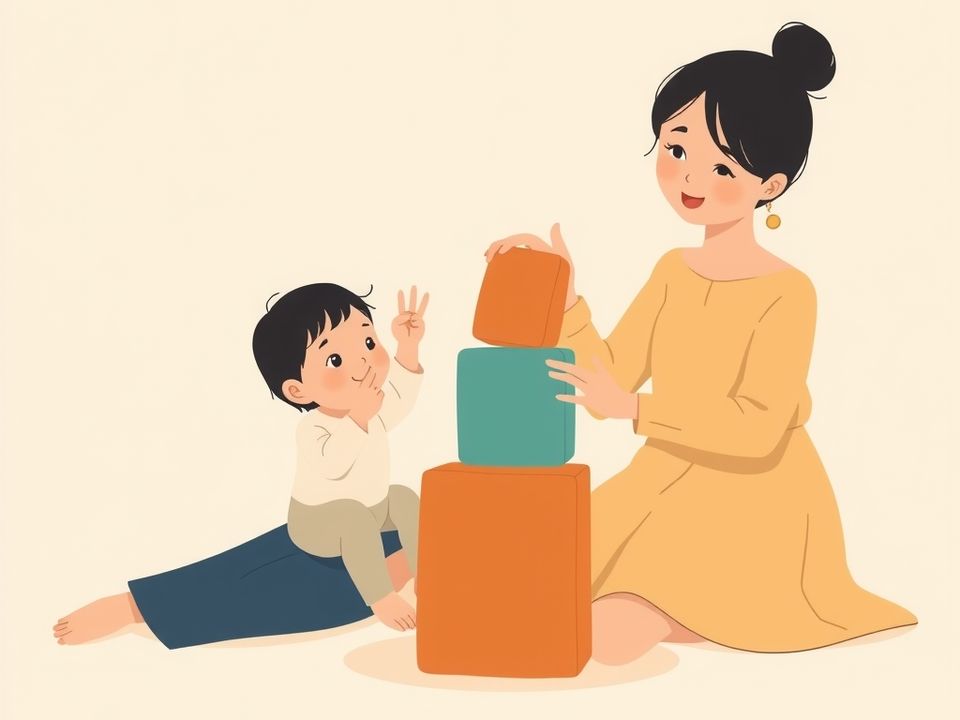
You put the big block at the bottom. Where should the little one go?
Praise: notice the effort
One study observed 53 families at home and followed the children for years. More praise for toddlers’ effort was linked with children believing, at 7-8 years old, that ability can grow, enjoying challenges and looking for ways to improve,140 and in a follow-up of the same children, a higher share of praise for effort and strategies at ages 1-3 was linked with better math and reading in fourth grade, through children’s belief that ability can grow.141 Mixed evidence.
That is one small group of families, and a link is not proof of cause. The same study also found that praising traits, such as “You’re so smart”, was not linked with fixed beliefs later on.140 Mixed evidence. So there is no need to watch every word; just get in the habit of saying what your toddler did.
- Describe the effort: “You kept trying.”
- Describe the strategy: “You turned it around and it fit.”
For praise as part of everyday discipline, see Specific praise and attention.
You turned it and turned it until it fit!
Motivation: let them do it
“Me do it!” is a big part of being a toddler, and that drive is worth protecting. Choices help: across 41 studies, having a choice raised intrinsic motivation, effort and performance, and the boost to motivation was stronger for children than for adults, with 2 to 4 choices in a row, and when no reward followed.46
Letting toddlers lead is not the same as having no limits. A review draws that line clearly, and reports that in observational studies, parents’ support for autonomy is linked with toddlers taking rules and values on as their own.80
Go easy on rewards for things your toddler already enjoys. Two meta-analyses disagree about how widely rewards harm motivation.134131 Mixed evidence. Both report, though, that tangible rewards promised in advance for an interesting task can reduce later interest in it.134131
- Offer two choices you are happy with, rather than an open question.
- Leave time for “me do it” when you are not in a rush.
For more, see Offering choices.
Do you want the red socks or the striped socks?
Numbers: count what you can see
In one study of 44 children, parents varied widely in how much they talked about numbers with their toddlers between 14 and 30 months, and more number talk was linked with a better grasp, at 46 months, of what number words mean (that “four” means a group of four things).144 Mixed evidence. Another study found that counting or naming how many things the child could see was the kind of number talk linked with this understanding, especially for groups of 4 to 10.139 Mixed evidence.
Across 64 studies, a richer home math environment was linked with higher math achievement, with an average correlation of r = .13 and large differences between studies.133
- Count things as you go: stairs, grapes, socks, cars.
- Point to each one as you count, then say the total: “One, two, three. Three cars!”
- Count bigger groups too, up to 10.
Let’s count your grapes. One, two, three, four, five. Five grapes!
Sleep and screens
The American Academy of Sleep Medicine recommends 11-14 hours of sleep per 24 hours at ages 1-2 and 10-13 hours at ages 3-5, naps included, in a statement the American Academy of Pediatrics endorsed.123 Sleep matters for focus too: a review notes that lack of sleep impairs the executive functions behind self-control and working memory.72
The AAP’s 2016 statement on young children and media recommended no screens other than video calls before 18 months; at 18-24 months, if parents introduce screens, high-quality programs or apps used together, because that is how toddlers learn best; for children over 2, no more than 1 hour a day of high-quality programs, shared with a parent; and screen-free meals with no screens in the hour before bed.110
In a study of 2,441 Canadian children, more screen time at 2 and 3 years was linked with lower scores on a developmental screening test at 3 and 5, with both screen time and development reported by mothers.86 Mixed evidence. The AAP’s newest policy, from 2026, notes that most digital platforms are designed to boost engagement and profit, not children’s health and development.122
For everyday screen struggles, see Screens; for bedtime, see Bedtime battles.
How sure is this?
- Fairly solid: shared reading, asking questions as you read and offering choices are backed by meta-analyses.14813646
- Expert guidance: the sleep hours and screen limits are recommendations from expert bodies.123110
- Promising but limited: the talk, praise and number-talk findings each come from single studies that observed families, so they show links, not proof of cause.78140144 Mixed evidence. See correlation and causation.
- Debated: how widely rewards undermine motivation.134131 Mixed evidence.
- Narrow benefits: guided play beat other approaches only on early math, shapes, task switching and words for space.154 Mixed evidence.
Sources
The small numbers in the text point to these sources. Each one has a full entry on the Research page.
- Patall, E. A., Cooper, H., & Robinson, J. C. (2008). The effects of choice on intrinsic motivation and related outcomes: A meta-analysis of research findings. Psychological Bulletin, 134(2), 270-300. See it on the Research page doi:10.1037/0033-2909.134.2.270 Back to the text
- Diamond, A. (2013). Executive Functions. Annual Review of Psychology, 64(1), 135-168. See it on the Research page doi:10.1146/annurev-psych-113011-143750 Back to the text
- Gilkerson, J., Richards, J. A., Warren, S. F., Oller, D. K., Russo, R., & Vohr, B. (2018). Language Experience in the Second Year of Life and Language Outcomes in Late Childhood. Pediatrics, 142(4), e20174276. See it on the Research page doi:10.1542/peds.2017-4276 Back to the text
- Joussemet, M., Landry, R., & Koestner, R. (2008). A self-determination theory perspective on parenting. Canadian Psychology / Psychologie canadienne, 49(3), 194-200. See it on the Research page doi:10.1037/a0012754 Back to the text
- Madigan, S., Browne, D., Racine, N., Mori, C., & Tough, S. (2019). Association Between Screen Time and Children’s Performance on a Developmental Screening Test. JAMA Pediatrics, 173(3), 244. See it on the Research page doi:10.1001/jamapediatrics.2018.5056 Back to the text
- Yogman, M., Garner, A., Hutchinson, J., Hirsh-Pasek, K., Golinkoff, R. M., Committee on Psychosocial Aspects of Child and Family Health, & Council on Communications and Media (2018). The Power of Play: A Pediatric Role in Enhancing Development in Young Children. Pediatrics, 142(3), e20182058. See it on the Research page doi:10.1542/peds.2018-2058 Back to the text
- American Academy of Pediatrics, Council on Communications and Media (2016). Media and Young Minds. Pediatrics, 138(5), e20162591. See it on the Research page doi:10.1542/peds.2016-2591 Back to the text
- Munzer, T., Parga-Belinkie, J., Milkovich, L. M., Tomopoulos, S., Ajumobi, T., Cross, C., Gerwin, R., Madigan, S., & American Academy of Pediatrics Council on Communications and Media (2026). Digital Ecosystems, Children, and Adolescents: Policy Statement. Pediatrics, 157(2), e2025075320. See it on the Research page doi:10.1542/peds.2025-075320 Back to the text
- Paruthi, S., et al. (2016). Recommended Amount of Sleep for Pediatric Populations: A Consensus Statement of the American Academy of Sleep Medicine. Journal of Clinical Sleep Medicine, 12(6), 785-786. See it on the Research page doi:10.5664/jcsm.5866 Back to the text
- Cameron, J., Banko, K. M., & Pierce, W. D. (2001). Pervasive negative effects of rewards on intrinsic motivation: The myth continues. The Behavior Analyst, 24(1), 1-44. See it on the Research page doi:10.1007/bf03392017 Back to the text
- Daucourt, M. C., Napoli, A. R., Quinn, J. M., Wood, S. G., & Hart, S. A. (2021). The home math environment and math achievement: A meta-analysis. Psychological Bulletin, 147(6), 565-596. See it on the Research page doi:10.1037/bul0000330 Back to the text
- Deci, E. L., Koestner, R., & Ryan, R. M. (1999). A meta-analytic review of experiments examining the effects of extrinsic rewards on intrinsic motivation. Psychological Bulletin, 125(6), 627-668. See it on the Research page doi:10.1037/0033-2909.125.6.627 Back to the text
- Dowdall, N., Melendez-Torres, G. J., Murray, L., Gardner, F., Hartford, L., & Cooper, P. J. (2020). Shared Picture Book Reading Interventions for Child Language Development: A Systematic Review and Meta-Analysis. Child Development, 91(2), e383-e399. See it on the Research page doi:10.1111/cdev.13225 Back to the text
- Gunderson, E. A., & Levine, S. C. (2011). Some types of parent number talk count more than others: relations between parents’ input and children’s cardinal-number knowledge. Developmental Science, 14(5), 1021-1032. See it on the Research page doi:10.1111/j.1467-7687.2011.01050.x Back to the text
- Gunderson, E. A., Gripshover, S. J., Romero, C., Dweck, C. S., Goldin-Meadow, S., & Levine, S. C. (2013). Parent Praise to 1- to 3-Year-Olds Predicts Children’s Motivational Frameworks 5 Years Later. Child Development, 84(5), 1526-1541. See it on the Research page doi:10.1111/cdev.12064 Back to the text
- Gunderson, E. A., Sorhagen, N. S., Gripshover, S. J., Dweck, C. S., Goldin-Meadow, S., & Levine, S. C. (2018). Parent praise to toddlers predicts fourth grade academic achievement via children’s incremental mindsets. Developmental Psychology, 54(3), 397-409. See it on the Research page doi:10.1037/dev0000444 Back to the text
- Levine, S. C., Suriyakham, L. W., Rowe, M. L., Huttenlocher, J., & Gunderson, E. A. (2010). What counts in the development of young children’s number knowledge?. Developmental Psychology, 46(5), 1309-1319. See it on the Research page doi:10.1037/a0019671 Back to the text
- Mol, S. E., Bus, A. G., de Jong, M. T., & Smeets, D. J. H. (2008). Added Value of Dialogic Parent-Child Book Readings: A Meta-Analysis. Early Education and Development, 19(1), 7-26. See it on the Research page doi:10.1080/10409280701838603 Back to the text
- Rowe, M. L. (2012). A Longitudinal Investigation of the Role of Quantity and Quality of Child-Directed Speech in Vocabulary Development. Child Development, 83(5), 1762-1774. See it on the Research page doi:10.1111/j.1467-8624.2012.01805.x Back to the text
- Skene, K., O’Farrelly, C. M., Byrne, E. M., Kirby, N., Stevens, E. C., & Ramchandani, P. G. (2022). Can guidance during play enhance children’s learning and development in educational contexts? A systematic review and meta-analysis. Child Development, 93(4), 1162-1180. See it on the Research page doi:10.1111/cdev.13730 Back to the text
- Whitehurst, G. J., Falco, F. L., Lonigan, C. J., Fischel, J. E., DeBaryshe, B. D., Valdez-Menchaca, M. C., & Caulfield, M. (1988). Accelerating language development through picture book reading. Developmental Psychology, 24(4), 552-559. See it on the Research page doi:10.1037/0012-1649.24.4.552 Back to the text