Encouraging learning
Encouraging learning: Babies (0-12 months)
In the first year, helping your baby learn starts with the most ordinary things: notice what your baby does, answer it, and give them a turn.
Start here
- When your baby coos, looks or reaches, answer: smile, name what they see, then pause so they can “reply”.156
- Talk to your baby face to face during feeds, diaper changes and bath time.
- Look at a sturdy picture book together for a few minutes: point, name, and follow your baby’s gaze.
- Give your baby time on the floor with safe things to explore, and play alongside.108
- Skip screens other than video calls for now.110
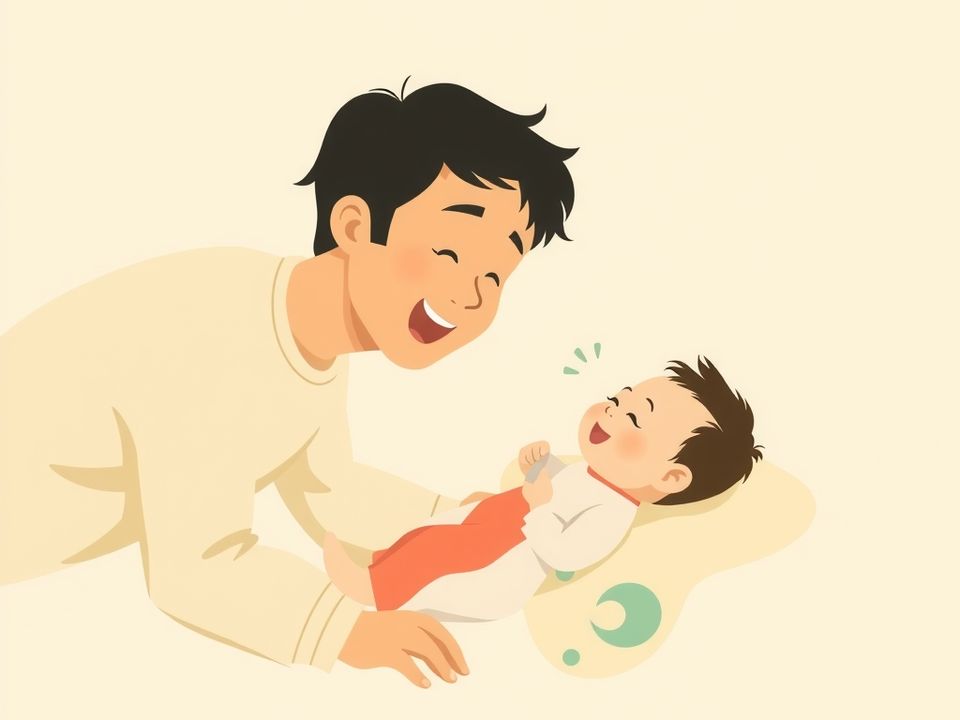
Talk: answer, then wait
Babies are learning language long before they say a word. Think of it as serve and return: your baby serves (a coo, a look, a reach), you return it (a smile, a word, a touch), and then you wait for the next serve.
Babies whose parents respond to them tend to do better. A review of infant research reports that parents’ responsiveness to their babies’ exploring and communicating predicts word learning,156 and in a randomized trial with mothers of full-term and very low birth weight babies, 10 home visits on responding to the baby made mothers more responsive than a comparison group between 6 and 13 months, which helped the babies’ social, emotional, communication and thinking skills grow.14
The same review suggests why: a reply that comes right away and fits what your baby is doing helps them link words to things, and shows them that language is a way to share what they mean.156
Speak to your baby, not just near them. In one study of Spanish-speaking families with low socioeconomic status, babies who heard more speech addressed to them processed familiar words more efficiently and could say more words by age 2, while talk they only overheard was not linked with their vocabulary.158 Mixed evidence.
- Get face to face, close enough to see each other’s expressions.
- Name what your baby looks at or reaches for.
- Copy their sounds, then wait. A few seconds can feel long, but it gives your baby a turn.
- Narrate ordinary routines: “Now the left sock. Now the right sock.”
Ba-ba-ba? Is that so? Tell me more!
Books: look, point, name
With a baby, reading mostly means looking, pointing and naming. Let your baby hold the book, pat the pictures and turn the pages out of order. When their eyes land on something, name it and add a little: “A duck! The duck says quack.”
Most reading research starts a little later. A meta-analysis of 19 trials that coached parents to share picture books involved children whose average ages were 1 to 6, and found small gains in children’s language and a large gain in parents’ book-sharing skills.136 So there is little trial evidence for the first year itself. Still, books give you endless things to talk about, and a few minutes a day is an easy habit to start now.
- Choose sturdy board or cloth books with clear pictures and faces.
- Keep it short, and stop when your baby loses interest.
- Songs and nursery rhymes count too.
Look, a duck! Quack, quack. And here’s a baby duck.
Play: follow your baby’s lead
Play is how babies explore their world. The American Academy of Pediatrics describes play with parents as a singular opportunity to build social, emotional, thinking, language and self-regulation skills, and as a way to build the safe, stable, nurturing relationships that children need to thrive.108
Let your baby choose what to explore. A review of parenting research reports that, in observational studies, parents’ support for their child’s autonomy is linked with babies’ motivation.80 At this age that can be as simple as letting your baby decide which toy to grab, and joining in rather than taking over.
You will not read every signal right, and that is normal. A review of research on babies’ emotional communication suggests that healthy development may go with interactions in which mix-ups happen often and get repaired, while long stretches of failed connection and distress go with poorer development.50 Missed cues are part of every relationship; what you can do is notice and reconnect.
- Floor time on the tummy and on the back, with a few safe objects: cups, spoons, soft balls.
- Peekaboo, hiding a toy under a cloth, rolling a ball back and forth.
- Check that everything within reach is too big to swallow.
Where did I go? Peekaboo! Here I am!
Sleep and screens
For babies 4-12 months, the American Academy of Sleep Medicine recommends 12-16 hours of sleep per 24 hours, naps included. Its statement, endorsed by the American Academy of Pediatrics, starts at 4 months and links getting enough sleep regularly with better attention, behavior, learning, memory and emotional regulation.123 For bedtime routines and night waking, see Routines and visual schedules, and Bedtime battles.
In its 2016 statement on young children and media, the AAP recommended avoiding screen media other than video calls before 18 months.110 So video calls with grandparents, or with a parent who is away, are fine under that advice.
Live people seem to matter for early speech learning: in one study, American 9-month-olds who had 12 lab sessions with Mandarin speakers in person held on to their ability to hear Mandarin speech sounds, while babies who heard the same Mandarin from video or audio recordings did not.119 Mixed evidence.
How sure is this?
- Fairly solid: responding to your baby supports language and development, backed by a review and a randomized trial.15614
- Expert guidance: the sleep hours and the screen advice are recommendations from expert bodies, not the result of a single trial.123110
- Limited: the findings on speech aimed at babies and on live versus recorded language each come from one study.158119 Mixed evidence.
- Little studied: the shared-reading trials in one meta-analysis involved children with average ages of 1 to 6, so the first year is not well covered.136
- Correlation, not cause: studies that observe families can show links but not prove cause. Correlation and causation explains why.
Sources
The small numbers in the text point to these sources. Each one has a full entry on the Research page.
- Landry, S. H., Smith, K. E., & Swank, P. R. (2006). Responsive parenting: Establishing early foundations for social, communication, and independent problem-solving skills. Developmental Psychology, 42(4), 627-642. See it on the Research page doi:10.1037/0012-1649.42.4.627 Back to the text
- Tronick, E. Z. (1989). Emotions and emotional communication in infants. American Psychologist, 44(2), 112-119. See it on the Research page doi:10.1037/0003-066x.44.2.112 Back to the text
- Joussemet, M., Landry, R., & Koestner, R. (2008). A self-determination theory perspective on parenting. Canadian Psychology / Psychologie canadienne, 49(3), 194-200. See it on the Research page doi:10.1037/a0012754 Back to the text
- Yogman, M., Garner, A., Hutchinson, J., Hirsh-Pasek, K., Golinkoff, R. M., Committee on Psychosocial Aspects of Child and Family Health, & Council on Communications and Media (2018). The Power of Play: A Pediatric Role in Enhancing Development in Young Children. Pediatrics, 142(3), e20182058. See it on the Research page doi:10.1542/peds.2018-2058 Back to the text
- American Academy of Pediatrics, Council on Communications and Media (2016). Media and Young Minds. Pediatrics, 138(5), e20162591. See it on the Research page doi:10.1542/peds.2016-2591 Back to the text
- Kuhl, P. K., Tsao, F.-M., & Liu, H.-M. (2003). Foreign-language experience in infancy: Effects of short-term exposure and social interaction on phonetic learning. Proceedings of the National Academy of Sciences, 100(15), 9096-9101. See it on the Research page doi:10.1073/pnas.1532872100 Back to the text
- Paruthi, S., et al. (2016). Recommended Amount of Sleep for Pediatric Populations: A Consensus Statement of the American Academy of Sleep Medicine. Journal of Clinical Sleep Medicine, 12(6), 785-786. See it on the Research page doi:10.5664/jcsm.5866 Back to the text
- Dowdall, N., Melendez-Torres, G. J., Murray, L., Gardner, F., Hartford, L., & Cooper, P. J. (2020). Shared Picture Book Reading Interventions for Child Language Development: A Systematic Review and Meta-Analysis. Child Development, 91(2), e383-e399. See it on the Research page doi:10.1111/cdev.13225 Back to the text
- Tamis-LeMonda, C. S., Kuchirko, Y., & Song, L. (2014). Why Is Infant Language Learning Facilitated by Parental Responsiveness?. Current Directions in Psychological Science, 23(2), 121-126. See it on the Research page doi:10.1177/0963721414522813 Back to the text
- Weisleder, A., & Fernald, A. (2013). Talking to Children Matters: Early Language Experience Strengthens Processing and Builds Vocabulary. Psychological Science, 24(11), 2143-2152. See it on the Research page doi:10.1177/0956797613488145 Back to the text